
Twin Elements · News & Events
2026 Rut Ready Event: Red Roar Film + Q&A At Venture Hunting
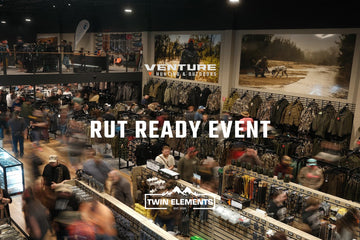
With the red stag roar and fallow buck rut just around the corner, we teamed up again with Venture Hunting & Outdoors for our 2026 Rut Ready event!
In This Report
- The Night
- The Cinematic Film
- The Event - Live Q&A
- Getting Hunting Access
- Scouting & Prepping New Ground
- Calling Strategy: Fallow, Red & General Principles
- Thermal (Winds) vs. Thermal Imaging
- Second Rut & Extended Rut Activity
- Meat Quality Through The Rut
- Meat Hanging & Ageing
- Elk vs. Red Deer
- What's Next
The Night
One hundred and seventy five guests attended on the night, with Ayden and James joined at points by Dustin from Venture. The night was sectioned into two main features.
Kicking off the evening we dropped our 2025 rut highlight bowhunting film.
It can be seen here: watch now
For those in attendance, we screened a twenty minute highlight reel with three epic bow kills.
We packed down all of the action from one month of bowhunting into twenty minutes so only the best encounters made it into the screening.
Event Images


The Cinematic Film
The main theme of the film was the distinction between hunting opportunities for red deer within different states and regions of Australia.
Take for example the Hunter Valley region of NSW, Australia, where there are less dense populations of red deer, however their genetics are truly impressive.
this differs to the Brisbane Valley region of south east Queensland where red deer are densely populated, yet antler quality typically lacks compared to NSW.
To drive this point home, we showed footage of a red spiker from NSW compared to QLD and the differences in length (and points incredibly) was very noticeable. As you take these changes and apply it to their second head, third head, fourth head and so on. Thats where you begin to see the difference between these two red deer herds.
Deer off the same age may be completely different animals by the time they reach maturity.
This can be seen in the images below, which capture some scenes from our rut film.
One thing that was clear after the twenty minute film. Viewers agreed, there was more than enough epic memories to make up for the twelve month wait until the next rut.
Chasing Genetics - Hunter Valley, NSW


Chasing Numbers - Brisbane Valley, QLD


The Event - Live Q&A
We then opened the floor to questions from those in attendance.
Below is a breakdown of what we covered, from getting landowner access to fallow and red calling strategy, butchering techniques, shot placement and how elk hunting compares with red deer.
Getting Hunting Access
Ayden and James both credit their veterinary work as a genuine door opener. Cattle work gives you an immediate, legitimate reason for a first conversation, and that naturally leads into asking about deer, pigs and goats on the property. The mindset that matters most is treating access as a privilege rather than an entitlement. Build rapport first, then generally offer something of value in return, whether that's a trade skill like plumbing, fencing or vet work, labour, time or money.
Talking about hunting to everyone you meet compounds over time. James's first ever hunting property came through several layers of personal connections. Starting with a mate who camp drafted (horse riding event) with someone, who was mates with someone who worked on the actual property. Follow the dots and eventually you’re having a conversation with the landowner.
For cold approaches, identify a region known to hold deer, pigs or feral animals you intend to hunt. From there use online tools (property or lease names, cattle company names, letterbox names) to find contact numbers, then call ahead of an upcoming trip. Most of the time it's a “No”. Yet we have found that notifying a potential landowner before you turn up to their property, measurably improves the odds compared to a cold door knock alone.
When you do door knock be extremely courteous and respectful of privacy.
Never open a closed gate.
Wait at the gate or find the owner in person. Ayden has door knocked plenty of properties in north Queensland and says most people are simply busy, not hostile. One line that reportedly works well in person is explaining that you're asking face to face, rather than just hunting without permission, precisely because you respect their privacy. That separates you from the unauthorised pig dogger or trespasser they're used to dealing with.
Access often starts small and builds. Shooting foxes to help save a neighbour's chickens can lead to a referral for a completely different property with deer.
That kind of access is built through reputation and referral over years. Paying for access is also a legitimate option that many hunters resist on principle while spending the same money on other hobbies. Finally, property saturation is real close to major cities, so expect to travel hours, not minutes, from a capital city for genuinely available access.
In this current landscape, with feral animals such as pigs and deer running rampant, its a great time to get out there and source legitimate access.
Your Questions Answered


Scouting & Prepping New Ground
On any new private property access, get the property owner to physically drive the boundary and show you around before you hunt alone. It avoids embarrassing and dangerous mix ups!
On very large properties, such as on a 20,000 plus acre block, it's genuinely possible to cross into a neighbouring hunting party utilising another paddock or section of the access.
A favourite scouting question to ask the property owner or manager of the access is "If you had to go shoot a deer, pig or goat right now, where would you go?", then have them take you there or specifically show you on maps.
Use a GPS or mapping app to track the roads you drive and pin everything of interest as the owner talks. Waypoints such as dams, water sources, wallows, crops, inaccessible bush blocks and good gullies. We run OnX maps. However “GPS KIT” is a cheap one off purchase app that works well offline here in Australia on both Android and iPhone. For $15 it allows you to add waypoints, add tracks, add images, etc.
After the initial drive around, walk the entire property on foot with an ultralight pack, not necessarily hunting seriously that trip, purely to build a mental map and assess sign like the freshness of rubs and wallow activity.
Owners can be wrong about what's on their land. Ayden recounted a property where the owner swore there were reds. After repeated dedicated searching, including trail cameras, none turned up, but it later proved to hold excellent fallow the owner hadn't mentioned.
Revisit properties across different seasons too, because animal presence on the same ground can shift dramatically month to month. A property that seems empty on one visit can be thick with animals months later.
On properties running cattle, ask the owner where the cattle currently aren't, because heavy stock pressure will often push deer out of an area even when old sign is still visible. More broadly, mark every dam, watercourse and wetter feeder gully or meadow, since nearly all game needs to feed, drink and shelter. For trophy focused hunting on a large, unfamiliar property, a trail camera on a promising water source is a low effort way to judge whether it's worth serious time.
Calling Strategy: Fallow, Red & General Principles
For most non rut hunting, the default strategy is spot and stalk without calling at all. Hunt with the wind in your face, walk a likely area, locate the animals and close the distance undetected first.
Only using a doe or hind call as a supplementary tool once you're already close.
With fallow, rattling and clashing of antlers is often most effective pre rut. Before the bucks have locked down does and built scrapes. At that stage few does are actually available, so a buck hearing rattling assumes a fight is happening over an in season doe and is more likely to investigate.
As the rut progresses, a well timed doe call can suggest a willing and able female and this often serves as the last piece to a successful buck hunt.
As a general principle across species, younger, more lustful males respond far more readily to calling than older, already paired up dominant males. To get a mature, tending male to commit, you often need to read the social dynamics in real time. Approaching as close as you can (often to around fifty metres with a bow, for example) can mean a satellite male interferes with his doe or hind and creates urgency for the dominant male to react and reassert control.
With red deer, the default method is either a roar or hind call depending on the situation.
We like to roar early in the mornings to locate a nearby stag then close the distance. Nine times out of ten, if a stag is roaring well on his own, then we will remain silent and close in on his location without making a sound.
If we need to roar to pin point a stag, we then move to within roughly one hundred metres depending on terrain, then switch to hind calls at closer range to draw him the final distance. That's especially useful when filming. How a stag responds to a hind call versus a roar depends heavily on rut stage and his situation. A stag holding a harem is unlikely to leave his hinds for a hind call, but the same stag late in the rut, once his hinds are confirmed bred, may be more willing to check out new calling.
We shared a real example of switching tactics mid hunt on a huge fourteen point red stag from last rut. Repeated roars on first light got no vocal response from a limping stag which we could see moving across fields below us. We assessed his limp, as likely being recently beaten in a fight and not looking for more conflict. Switching to hind calls rather than roaring, got an immediate reaction, and he began roaring back and moving in. In another case, persistent hind calling and roaring back and forth over roughly two hours pulled a stag from about eight hundred metres across a boundary fence. The core message from both Ayden and James is that there's no fixed formula to calling.
Read what's working in real time and adapt, whether that means roaring, hind calling or staying silent and repositioning.
Calling Tips


Thermal (Winds) vs. Thermal Imaging
"Thermals" in most of our hunting discussion means rising warm air currents, and sinking cool air particles.
Not to be mistaken with the new craze of thermal imaging optics!
There was initially some confusion after a attendee of the event asked about our position on “thermals” and we started talking about the wind.
Saying “work out in advance roughly what time of day thermals will begin shifting where you hunt. Understand the time when cool air begins sinking in both morning and afternoon, because that informs whether you approach a gully from the bottom, side or top at a given hour.”
After clarification about the question wanting to touch on technology, we also addressed thermal imaging optics directly.
Whilst we don't personally hunt with thermal scopes or monoculars, we’re careful not to criticise others who choose to use them.
We view it as ethically borderline for our own standards of fair chase hunting. Although we're explicitly supportive of thermal use for genuine pest control culling and eradication of feral animals.
We acknowledged that our retail partner Venture sells thermal gear and the fact that many people now use them across Australia.
Second Rut & Extended Rut Activity
We get asked about this “Second Rut” observation quite a lot.
As a rule of thumb, for both falls and red deer, the shortening of day length dictates their fertility and when to rut. For hinds and does, this allows them to have their paws in summer when its advantageous for a mass arrival of fans on the landscape at the same time. Throughout most of Australia that coincides with a late March, Early April peak in rut.
Roughly 21 days after peak rut activity occurs in a region or hunting area is when any does that weren't bred during their first cycle will come back into oestrus. That mirrors the standard cycle length in domestic cattle breeding programs. Ayden's professional estimate from his veterinary background is that very few wild fallow does go unbred on a first cycle. It's rare for a healthy doe not to be pregnant within a month of the main rut. Regardless of how much perceived rutting behaviour us as hunters actually observes. for example, even if we think day time croaking or roaring is minimal and bucks aren’t around, the does are likely being bred in cover or under nightfall.
A visible second rut period can also partly be explained by first time breeding yearlings from the previous years fawn drop coming into oestrus for the first time. These younger, generally smaller animals may cycle later as they mature later and this can add a secondary wave of activity, often seen in May and sometimes June.
The practical advice is to keep hunting through the whole rut window and beyond, into May and June, rather than assuming activity has to be constant. Pre rut and post rut bucks can be easier to kill than mid / peak rut bucks in some respects. Since does are often smarter and more switched on than males all year round.
Meat Quality Through The Rut
Both James and I, largely dismiss strong claims from other hunters about rutty buck meat and gaminess as overstated in our own experience. We put any perceived quality differences between animals taken from the rut and out of rut down mostly to processing and handling rather than the rut itself. Of course a post rut buck will have different meat quality to a velvet buck of the summer.
Yet the following example should highlight what we prioritise most when it comes to processing our meat.
A deer left with guts in, un processed, sitting in the sun for a couple of hours will taste noticeably worse than one field dressed immediately.
That can include quartering or gutting, packed out and hung, then cooled quickly, regardless of season.
We're also self aware that after around a decade of venison making up ninety percent or more of our household protein, we may not be the most sensitive judges of subtle gaminess.
In Ayden's professional opinion, a pregnant fallow doe in winter, having weaned the previous years fawn, regained enough condition to get pregnant again and now carrying a small early stage foetus, is often close to the best conditioned, best eating animal available.
That's in contrast to a doe (or any lactating female) shot in summer while still nursing a dependent fawn, which raises both welfare and eating quality considerations.
James shoots several hundred does a year on some fallow properties for population management, generally outside the rut window, since rut season hunting effort is focused on bucks and stags.
Ayden does similarly up north in Queensland as part of his “Spotted Safaris” chital deer meat hunts.
Meat Hanging & Ageing
When asked a follow up on ageing meat, James keeps his ageing to a minimum, more so due to logistics and storage compared with necessity.
James agrees, if he could, he would hang all meat and undertake the necessary aging process for better meat quality.
Instead, his meat comes home, is trimmed and typically vacuum sealed into cryovac bags. This includes backstops (steak), muscle groups or one inch chunks (slow cook) and mince. This is mostly done the same day or the next with meat remaining in a cooler with ice until ready to be processed. James prioritising a fast turnover over dry or wet ageing simply due to how much meat he consumes and how he eats it.
He runs three main outputs from any animal: steaks, slow cook recipes and mince.
Ayden prefers to age meat when facilities allow, 7-14 days depending on animal size and whether it's bone in or boned out. When he has access to large scale, proper cool room such as at his North Queensland guiding operation Spotted Safaris. When a cool room isn't available or needs clearing quickly, the compromise Ayden suggests is to butcher and cryovac promptly, which creates an anaerobic, low bacterial environment, then store the vacuum sealed meat in a regular fridge for one to two weeks as a form of wet ageing. That's particularly beneficial for cuts destined to be steaks or schnitzels. For any pieces designed to be slow cook, roasts or mince, he will simply vacuum seal and freeze immediately to save on fridge space.
Elk vs. Red Deer
When complimented on their recent USA adventures and images on social media, Ayden and James were asked about the similarities and differences of bull elk, compared with red stags.
One of the biggest differences to note is how much elk move across the landscape. They cover serious ground even without direct pressure, and at times when hunting in Montana, we found ourselves needing to jog just to keep pace with a herd that was merely walking.
On the contrary, here in Australia, red deer tend to stay within a home range, such as a basin or system. The Montana foothills also dwarf typical Australian red deer country in terms of remoteness, size and scale and elevation.
Another difference we found, is to do with the calling.
Bulls with larger harems, common in high density herds on USA public land, are markedly less responsive to cow calls than red stags with smaller hind numbers. One more female matters far less to a bull already holding twenty to thirty cows than to a stag with two or three hinds. Therefore a red stag is more motivated to respond and investigate, making them potentially more easy to call into bow range.
Elk are also extremely pressure sensitive on public land. A single spooked animal, even an unrelated species like a nearby mule deer, can send an entire herd fleeing miles with no direct contact.
Red deer in Australia, particularly in higher density south east Queensland country, are much more tolerant of incidental disturbance such as spooking a kangaroo or a couple of other deer. A stag may simply stop roaring for a while rather than leaving the area.
What's Next
A huge thank you to everyone who showed support for the event.
We’re absolutely blown away by the incredible turn out and feedback from the night.
A huge shoutout also goes to the amazing brands who sponsored the night and gave attendees the opportunity to win some amazing gifts.
For those that missed the event and didn’t secure a spot this time, please note that we intend to do many more of these events in the near future.
Keep your eyes and ears peeled for that one.
By subscribing to our newsletter (link to website) you can stay up to date with all Twin Elements news and events.
We hope you enjoyed the experience, connected with like-minded individuals, and found value in the discussions and activities. Events like this wouldn’t be possible without such an engaged and enthusiastic community.
Lastly thank-you to the team of legends at Venture Hunting and Outdoors, we appreciated the opportunity to work with you and give back to the greater hunting and outdoor community.
Visit Venture Hunting & Outdoors: venturehunting.com.au
Shop Our Prints


The Adventure Continues
Keep an eye out for the next Twin Elements event.
Want more from the field? Listen to the podcast or watch on YouTube.