
Twin Elements · Hunting Tips & Tactics
The Pointy End: A Deep Dive Into Broadheads
Of all the gear conversations that come up online, whether through groups on facebook such as "Hunting Australia", a comment thread on an instagram post, even listener questions sent in to the Twin Elements Podcast.
None get more heated, with more varied preferences, than broadhead selection.
Everyone's got an opinion. Fewer people have actually tested one against another with real numbers behind it.
We recently sat down with Grant Rand, a keen Australian bowhunter and one of the owners behind Kayuga Broadheads. Grant lives and breathes this stuff, and he came armed with genuine data from a wide sample of broadheads on the market.
We deep dive into factors such as broadhead design, sharpness, edge retention and penetration. We compared two blade against three blade, fixed against mechanical, single bevel against double, and got into the actual mechanics of why a broadhead does what it does once it's inside an animal.
Everything below is the practical version of that conversation. The trade-offs, the field stories, and the actual test numbers behind the broadheads we now run ourselves.

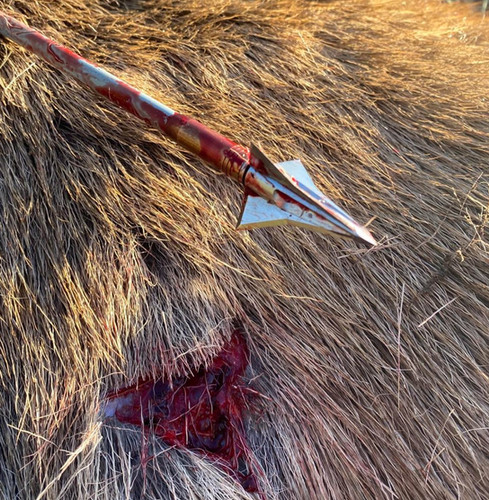
A shaving sharp broadhead, placed in the vitals leads to the most noble of kills.
In This Report
- Two Blade vs. Three Blade
- Fixed vs. Mechanical
- Single Bevel vs. Double Bevel
- Grain Weight and FOC
- Vented vs. Solid Broadheads
- The Sharpness Test
- The Edge Retention Test
- The Penetration Test
- Why We Shoot Kayuga
- FAQ: How To Sharpen A Broadhead
Two Blade vs. Three Blade
This is the trade off every bowhunter runs into eventually. A two blade broadhead gives you the best penetration for a given amount of kinetic energy, full stop.
Less material pushing through hide, muscle and bone means less resistance, which matters most on the big, thick-skinned species such as buffalo, boars with a fighting shield, banteng, scrub bulls, that kind of animal.
A three blade trades some of that penetration for a larger cut diameter and a rounder wound channel. More cutting surface generally means a better blood trail, provided the animal isn't so thick skinned that the extra resistance costs you a clean pass through.
Noting that a clean pass through means an entry and exit hole. Something that with better penetration, you generally achieve.
Where Grant's and the teams at Kayuga's design work gets interesting is bleeder blade technology. With a bleeder blade, youre essentially pairing the unbeatable penetration of a two blade broadhead, with the extra cutting diameter and increased wound channels of a three blade.
How? I hear you ask.
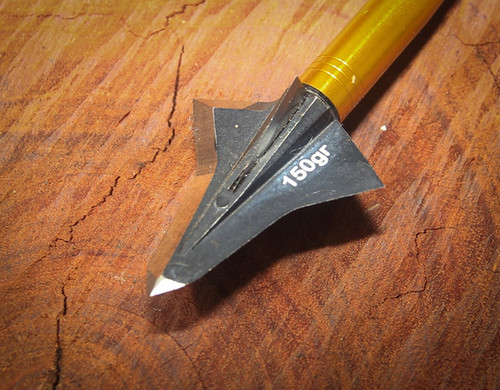
Lets look at their "Pilot Cut" style of head.
It effectively gives you the benefits of multiple broadheads in one. The main solid construction, two blade point does the penetration work. While the small rear positioned bleeder blades sit further back on the ferrule to open up the wound channel without meaningfully affecting the head's ability to drive through. You get the penetration profile of a two blade with a lot of the cutting benefit of a three blade. It's not a gimmick, it's a genuine engineering answer to a trade-off that's existed as long as broadheads have.
Two Blade


Fixed vs. Mechanical
Mechanicals fly beautifully. Advertised field-point accuracy out to genuinely long ranges is the whole sell, and for a lot of hunters shooting light arrow setups, in open country, that matters more than anything else on this list. But heres where a mechanical falls apart for us.
A Mechanical broadhead rely's on a moving part deploying correctly under load to cut and perform. This is where the term cut on contact applies. When that goes wrong in the field, and a mechanical head doesn't deploy it goes wrong at the worst possible moment.
Fixed blades don't have that failure point. What you sight in and send towards an animal you intend to kill, is exactly what's cutting on impact, every time, regardless of what the head clips on the way through. Whether its a blade of grass, leaf matter, any vegetation. The fixed blade head is more forgiving.
From the Field


Wherever the hunt takes us, whatever the species, we have utmost confidence in Kayuga Broadheads.
Single Bevel vs. Double Bevel
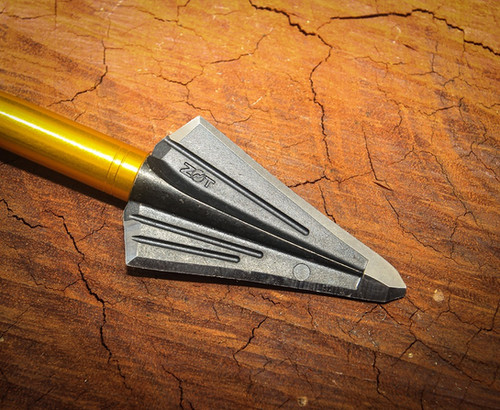
A double bevel is ground symmetrically on both sides of the edge and tracks dead straight through tissue, no surprises, easy to tune easier to sharpen.
A single bevel is ground on one side only, and because of that asymmetry the head actually rotates slightly as it drives through the animal. That rotation creates a wider, more disruptive wound channel than the blade width alone would suggest, similar in principle to rifling on a bullet.
I've got my own story that lines up with exactly what Grant described. We had a fallow buck where the single bevel head clipped the heart on an angle that, on paper, shouldn't have been a clean kill. The rotation of the head through the chest cavity opened things up far more than the entry wound suggested it would, and the buck was down inside seconds. A double bevel taking that same marginal line likely tracks straighter and produces a narrower channel, and the outcome could easily have been a much longer recovery.
That rotational effect is also a big part of why single bevel heads consistently show better blood trail recovery rates in Grant's data. It's not just anecdotal, the physics of a rotating wound channel genuinely does more damage to soft tissue on the way through than a straight one.
The biggest consideration with single vs double bevel from our side, and a hunters perspective. More hunters use double bevel as the blade edges and angles are relatively standardised.
When comparing a ZOT by Kayuga, to a Pilot Cut, both are solid two blade broadheads. However the single bevel, unique shape of the pilot cut seems to frighten people away, rather than attract because of its benefits. Something to consider.
Single Bevel


Grain Weight and FOC
Front of centre, or FOC, is how much of an arrow's total weight sits forward of the midpoint, and it's one of the most misunderstood numbers in archery. Higher FOC generally means a more stable arrow in flight and better penetration on impact, which is why it gets pushed so hard. But there's a genuine ceiling to how far you can push it.
One thing Grant flagged that surprised me is just how different broadhead weight norms are between Australia and the US. Aussie hunters tend to run heavier heads, typically 125 to 150 grain, largely because of the bigger, tougher bodied game we're regularly shooting. American hunters more commonly sit in the 100 to 125 grain range. Neither is wrong, it's a reflection of what's walking around in front of you.
Where it gets genuinely important is at close range.
Push FOC too high with an overly heavy head on a light shaft, and the arrow can develop a visible wobble in the first fifteen metres or so of flight, before it's fully stabilised.
For most bowhunters getting too close, isnt an issue, but if you're stalking tight creeks or bedded boars, up in Cape york Australia. Taking shots through undergrowth at a mere 7 meters from a bedded hog. Then you need to know that your arrow and broadhead stabilses quickly coming out of your bow.
If you take the shot at seven meters, but it takes your setup twenty on average to fully stabilse then you may get unwanted arrow flight.
Leading to things such as deflections, poor penetration, and ultimately not finding animals.
It's worth knowing that more weight up front, doesn't just come free. There's also a hard mechanical limit.
For example, push the combination of head weight and spine mismatch far enough and you risk a snapped shaft at the point of impact rather than a clean pass through, which is the last thing you want happening on a big bodied animal at close range.
Double Bevel


Wound Channels & Blood Trails


When it comes to wound channels, two blades are fine, three are better, four is best. Now apply this to a broad head thats going to penetrate regardless of extra surface area. With extra cutting blades, you create larger wound channels and thus larger, easier to follow blood trails.
When you look through this image carousel, take note of the irregular cut holes in these animals. Irregular holes (compared to a clean two blade slit) prevent the hole from sealing and act as a drain, allowing blood to pour from the animals as they move.
Another consideration when it comes to wound channels. Two holes are better than one.
The Sharpness Test
This is where the conversation stopped being opinion and started being data.
Grant uses the BESS scale, (Brubacher Edge Sharpness Scale) a proper industry standard for measuring edge sharpness in grams of force required to cut a test filament. Lower numbers mean a sharper edge.
For reference, a surgical scalpel blade, about as sharp an edge that exists commercially, sits at roughly 156 grams on the BESS scale. Kayuga's Pilot Cut and TriZot heads test between 155 and 158 grams straight out of the packet. That's genuinely scalpel sharp. The competitor range Grant tested against ran anywhere from 143 grams right up to 758 grams, meaning some heads on the market need nearly five times the force generated to make the same cut. That's an enormous spread for something that's meant to do one job.
The Sharpness Test


Shot placement and broadhead sharpness is what kills. Optimising for penetration, extra blades, bleeders, all of these traits are great. However placing a shaving sharp broadhead through the vitals is key. Rather than a dull head pushing through an animal, if it slices and dices every single thing it comes in contact with, its going to cause more haemorrhage, which is exactly how bowhunters kill efficiently.
The Edge Retention Test
Sharp out of the packet is one thing. Staying sharp after you've actually driven it through bone is the number that matters in the field. Grant re-tested the same Pilot Cut heads on the BESS scale after shooting them through bone, and the edge held up from 155 grams to 183 grams, a small, genuinely usable amount of degradation. The single bevel grind held its edge marginally better again than the double bevel in the same test.
Some of the competitor heads Grant tested told a very different story, degrading by more than a full kilogram of BESS force after the same treatment. That's the difference between a head that's still doing useful work and going to perform time and time again. On many of our remote top end hunts, knowing that with a light touch up, that same broadhead from the first critter, is going to perform on your second animal of the day matters.
The Edge Retention Test


Whilst broken down with car issues, we took it upon ourselves to perform a durability / edge retention, destruction test on our Kayuga Broadheads.
As expected, after getting the head back from a tree trunk, with the use of the chainsaw, the broadhead was flawless. Ready to be sent through a Cape York boar after a quick re sharpen.
The Penetration Test
The last piece of Grant's testing used an arbor press to measure exactly how much force is required to drive each head through a set medium, giving a genuinely objective penetration comparison rather than a subjective "feels like it flies through" impression.
The numbers were stark.
The ZOT required 21.65kg of force compared to a competitor head needing 29.98kg for the same result, a 38.5% difference for what's meant to be doing the same job.
The Tri Zot pushed that gap even further, requiring up to 201% less force than the three blade competitor head it was tested against in that run. The Pilot Cut, despite carrying bleeder blades, needed 45.5kg against a competitor's 61.05kg, a 34.2% difference. Carrying bleeder technology and still out-penetrating a simpler two blade competitor design is the real proof that the engineering behind the Pilot Cut is doing what it's meant to.
Bleeders


Bleeders are mans best friend. They are like insurance for your shot. Enjoy the benefits of a two blade broadhead for penetration, with the wound channels of a four blade.
Thats what bleeders achieve.
The same penetration, bigger holes and faster kills.
Why We Shoot Kayuga
I'll be upfront, Kayuga is a partner of the podcast, so take this section for what it is.
Although, the honest answer to why we've stuck with them isn't surface level. It's the numbers above and one detail Grant mentioned almost in passing that's stuck with me since.
Kayuga Broadheads run a one grain quality control tolerance across their broadhead line. Every head off the shelf sits within a single grain of its stated weight.
That might sound like a small thing until you think about what it actually means for tuning. An arrow that's balanced and tuned around a 150 grain head stays balanced when you swap heads between hunts, restock mid-season, or hand a spare to James or Dad. You're not re-tuning your setup every time a new batch of heads turns up, and you're not second guessing whether today's inconsistent grouping is you or the gear.
Combine that manufacturing consistency with the sharpness, edge retention and penetration numbers Grant walked through, and it's genuinely hard to find a rational reason to run anything else on the animals we're chasing. That's the whole case, not marketing, just what the data and two decades of us cutting animals open afterward actually shows.
Matt Moore, Grant Rand and Ian Summers are the minds behind Kayuga Broadheads and together Kayuga’s products are helping bowhunters become more efficient, better prepared and ultimately better hunters. Not just here in Australia, but abroad.
FAQ: How To Sharpen A Broadhead
A few listeners wrote in after we recorded this one asking how we actually keep an edge sharp between hunts, so it's worth covering properly rather than leaving it as an afterthought.
For fixed blade heads, a 150mm half-round smooth file is the tool Grant recommends, and genuinely the only one worth bothering with for restoring a dull or nicked edge from scratch. The half-round profile lets you match the existing bevel angle rather than fighting it, and the smooth cut (as opposed to a coarse or bastard cut) won't chew up the edge while you're working it.
File quality matters more than people expect here too.
You want to use a file sitting in the 46 to 48 Rockwell hardness range, anything softer just won't cut hardened steel efficiently and you'll be there all afternoon for a mediocre result.
Once you've got a true edge back with the file, a ceramic stone or leather strop is all you need for touch-ups between hunts, keeping that edge at scalpel sharpness without removing much material each time. Save the file for genuine damage or a full re-profile, not routine maintenance.
Gear List
Shop Our Prints

Chasing Bugles
From $75.00 AUD

Axis Axis
From $75.00 AUD

Stare Down
From $75.00 AUD

Mountain Muley (Portrait)
From $75.00 AUD
The Adventure Continues
Join the Twin Elements team as they head back into the Australian bush.
Want the full story behind this episode, in Ayden and Grant's own words? Listen here.
Prefer to see it play out on camera? Watch the next adventure on the Twin Elements YouTube channel.


